In space science, "lucky timing" usually means catching a launch window or syncing a flyby to within a few hours. What NASA's Hubble Space Telescope just managed is on a different scale entirely.
On three consecutive nights - 8, 9, and 10 November 2025 - Hubble pointed at a small, recently-discovered comet called C/2025 K1 (ATLAS) to grab a few quick "context" images before a planned spectroscopy run. By chance, those images caught the comet in the act of breaking apart. Five pieces, each with its own glowing coma, separating across the field of view night after night.
NASA's official description of the odds? "Extraordinarily miniscule." In the words of one of the astronomers on the project, "the slimmest of slim chances."
This is the story of one of the luckiest scientific accidents of the decade - and why it's a much bigger deal than "Hubble got a pretty picture."
What Hubble actually saw
The comet had been on astronomers' radars since 24 May 2025, when the ATLAS survey in Chile spotted it as a faint 19th-magnitude object in the constellation Pegasus. It was a small, dynamically new comet - about 1 to 2 km across - that had drifted in from the Oort cloud, the vast spherical shell of icy debris on the far edge of the Solar System where most long-period comets are born.
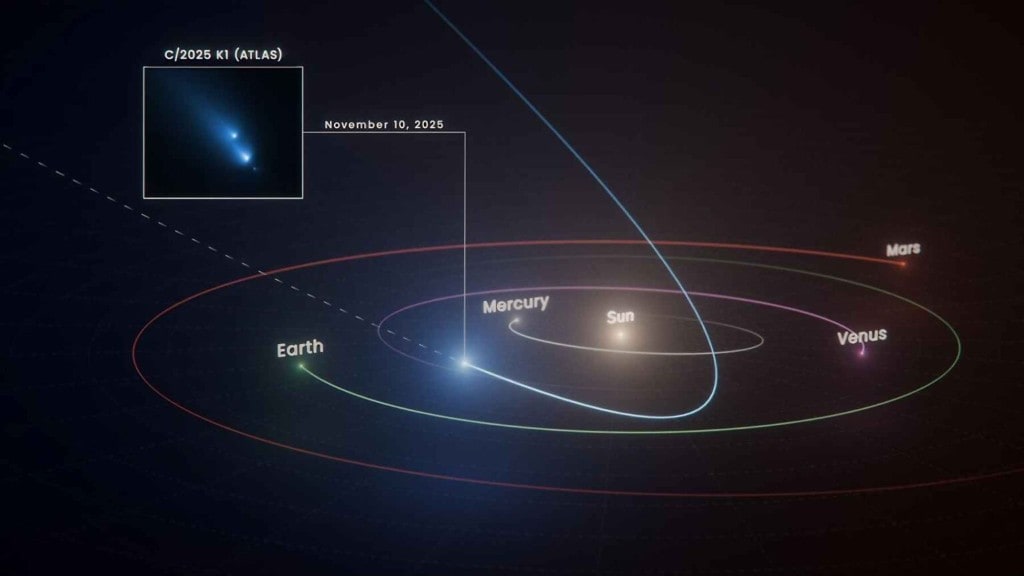
C/2025 K1 was on a near-suicidal trajectory. On 8 October 2025, it passed just 0.33 AU from the Sun - well inside Mercury's orbit, around 49 million kilometres from the surface of a star. Most astronomers expected it to vaporise outright. It didn't. It survived perihelion, and was recovered by ground-based telescopes on 18 October.
But it survived in pieces.
Beginning around 2–4 November 2025, the Las Cumbres Observatory's outburst-monitoring project (LOOK) saw the comet brighten by almost a full magnitude. Its inner coma rapidly developed two distinct components - a sign that something inside the nucleus had given way. Within days, ground-based telescopes from Teide Observatory in Spain to amateur observers in France were reporting multiple fragments.
Hubble's images on November 8, 9, and 10 - taken with the Space Telescope Imaging Spectrograph (STIS) at 20.5 seconds per exposure - showed the breakup in detail no ground telescope could match: at least five fragments, each with its own well-defined coma, drifting apart from one another night by night. The Hubble team labels them A through D (with a slow secondary split visible in fragment II as well).
"Most of the time, it's a few weeks to a month later. And in this case, we were able to see it just days after," said Prof. John Noonan of Auburn University, a co-author on the study. "Never before has Hubble caught a fragmenting comet this close to when it actually fell apart."
That timing is the entire scientific point. Most of what we know about how comets disintegrate comes from observations made long after the breakup, when the fragments are already drifting kilometres apart and the freshly-exposed interior has had time to cook in sunlight. Hubble caught this one within roughly a day of the actual disruption - an unprecedented look at the physics of cometary breakup at the moment it happens.
The 'extraordinarily miniscule' odds
You don't normally get to use the word "miracle" in a peer-reviewed paper. So how did Hubble end up pointing at the right comet at the right moment?
Pure substitution.
The team had a different comet lined up as their original Hubble target. Then, after their proposal was approved, new technical constraints on Hubble made that target unobservable. They scrambled to find a backup. C/2025 K1 was a recently-discovered Oort-cloud visitor - a perfectly fine secondary target.
"This comet got observed because our original comet was not viewable due to some new technical constraints after we won our proposal," Noonan told Sci.News. "We had to find a new target - and right when we observed it, it happened to break apart, which is the slimmest of slim chances."
Think about the layered improbabilities here:
- The Oort cloud sends very few comets onto sunward trajectories in any given year.
- Of those, only a fraction fragments at all.
- Of those that fragment, almost none are caught within days of breakup - most are spotted weeks later.
- And of those, almost none happen to be the backup target on a Hubble proposal that was already in motion.
The team estimates the actual breakup began around 1 to 3 days before Hubble's first image on November 8 - which means the alignment of "comet falls apart" and "Hubble takes a picture of it" was a window measured in hours, not days. The Bodewits et al. paper, now published in Icarus (February 2026), is unambiguous about how unusual this is.
Why this matters for the science of comets
A comet's nucleus is a dirty snowball - frozen water, carbon dioxide, methane, organic compounds, and dust, all mixed together and dating back to the formation of the Solar System about 4.6 billion years ago. The interior of a comet is, in a real sense, pristine material from the dawn of our planetary system. We almost never get to see it directly.
Most of the time, sunlight only ever touches a comet's outer surface - a sun-baked crust that has lost most of its volatiles and built up a dust mantle over many passes through the inner Solar System. Fragmentation is one of the rare moments that crust cracks open and the original interior gets exposed.
What Hubble + ground-based observations together pinned down for C/2025 K1:
- A consistent 1–3 day delay between the actual breakup and the brightening event. This is a genuine physics finding - it suggests freshly-exposed interior ice needs time to thermally adjust before it can release dust and gas efficiently. The team draws an explicit analogy to delayed activity following the cliff collapses on Comet 67P that the Rosetta mission watched in detail.
- Short-lived "arclets" of dust around one of the fragments in the very first Hubble epoch - direct evidence that dust shells release in waves as the new surface warms up, rather than being driven out by gas pressure.
- Hierarchical fragmentation - the comet didn't just split in two. It split, and then one of the fragments split again. That's likely driven by rotational instability: as outgassing speeds up around the breakup, the torque it produces can spin the nucleus faster and faster until centrifugal forces tear it apart further.
In other words, this single set of three Hubble images - taken almost by accident - is now the earliest high-resolution timing benchmark astronomers have for the entire physical process of how a comet falls apart near the Sun.
What was special about C/2025 K1 itself
This wasn't an ordinary comet, even before it broke up. Spectroscopic measurements from the Asiago Observatory in Italy and Lowell Observatory in the US (August 2025) found C/2025 K1 had one of the lowest CN-to-OH ratios ever measured in any comet - meaning it was bizarrely depleted in carbon-bearing molecules.
Only two other comets are known to be that carbon-poor: C/1988 Y1 (Yanaka) and 96P/Machholz. Both are so chemically odd that researchers have seriously suggested they might be interstellar interlopers - comets that didn't form in our Solar System at all, but were captured from another star.
C/2025 K1 wasn't quite that exotic - its orbit traces neatly back to the Oort cloud - but its chemistry is in the same unusual neighbourhood. So when Hubble cracked it open and spilled fresh interior material into space, it was peeking inside one of the strangest comets ever spectroscopically catalogued.
Could you see it from India?
Briefly, yes - though by the time it was breaking up, you needed equipment.
C/2025 K1 made its closest approach to Earth on 24 November 2025, passing about 0.40 AU (60 million km) from us. At that distance the brightest fragment was around magnitude 12 - well below naked-eye visibility, but within reach of a decent 8-inch (200 mm) backyard telescope under properly dark skies.
Indian amateur astronomers in Ladakh, the Western Ghats high country, and dark-sky sites in Rajasthan and Madhya Pradesh would have had reasonable shots at it through November and December 2025, when it was tracking through the Big Dipper (about 12 degrees from the bright star Dubhe) before fading.
Today, in late April 2026, the fragments are now roughly 400 million km from Earth in the constellation Pisces, drifting permanently away from the Sun.
The fragments' final fates
Each fragment now has its own slightly different orbit. According to JPL Horizons computations:
- Fragments A, B, and D are on hyperbolic trajectories - meaning they're moving fast enough to escape the Solar System entirely. They will never come back.
- Fragment C is on a barely-bound elliptical orbit, with a calculated period of roughly 449,000 years. If it survives that next half-million-year journey, it could one day return.
Fragment C, incidentally, fragmented again - that secondary split was caught by the James Webb Space Telescope in January 2026 and by Gemini North in December 2025. The story isn't quite over.
Why Hubble's lucky shot helps a future ESA mission
This kind of close-up of a fragmenting long-period comet has direct practical value for one specific upcoming mission: ESA's Comet Interceptor, due to launch toward the end of this decade.
Comet Interceptor is a first-of-its-kind mission. Instead of being launched at a known target (the way Rosetta was sent to chase down 67P), it will park itself at a stable point in space and wait - for years, if necessary - for a brand-new long-period comet to be discovered on a trajectory it can intercept. Then it will be released to fly through that comet's coma and image its nucleus up close.
The catch: long-period comets are far more likely to fragment than the short-period comets that have been visited so far. Astronomers don't yet fully understand why. Choosing a target that will hold together long enough for a flyby is one of the mission's hardest problems.
"Hubble's chance observation of C/2025 K1 (ATLAS) will help us understand why some long-period comets split apart and give us a first view of their interiors," said Prof. Colin Snodgrass of the University of Edinburgh, a Comet Interceptor science team member and a co-author on the K1 study. "These new results will complement the detailed view of a long-period comet that we will obtain from Comet Interceptor, as well as helping astronomers to select the mission's target."
Translation: the lessons learned from a 20-second exposure that almost didn't happen are now baked into the planning for an interplanetary mission that hasn't even launched yet.
The bigger lesson
There's a quieter point underneath all this, and Prof. Noonan said it best:
"Sometimes the best science happens by accident."
It does. But "by accident" is doing a lot of work in that sentence. Hubble was already pointed at the sky. The LOOK Project was already monitoring outbursting objects nightly. ATLAS had already discovered the comet months before. The proposal infrastructure had already greenlit the spectroscopy run. None of those things happened by accident - they happened because we have a worldwide, decades-deep apparatus quietly pointed at the sky every clear night.
When the comet finally cracked open, the watchers were already in position.
That's worth remembering the next time someone asks why we keep funding telescopes that "just look at things." This is what looking at things gets you: a five-piece, billion-year-old time capsule, photographed in the act of breaking, by a 35-year-old space telescope, on the evening the universe happened to oblige.
You can read the full peer-reviewed paper - Bodewits et al., "Sequential Fragmentation of C/2025 K1 (ATLAS) After Its Near-Sun Passage" - in the February 2026 issue of Icarus, or follow more Hubble discoveries on our astronomy section.