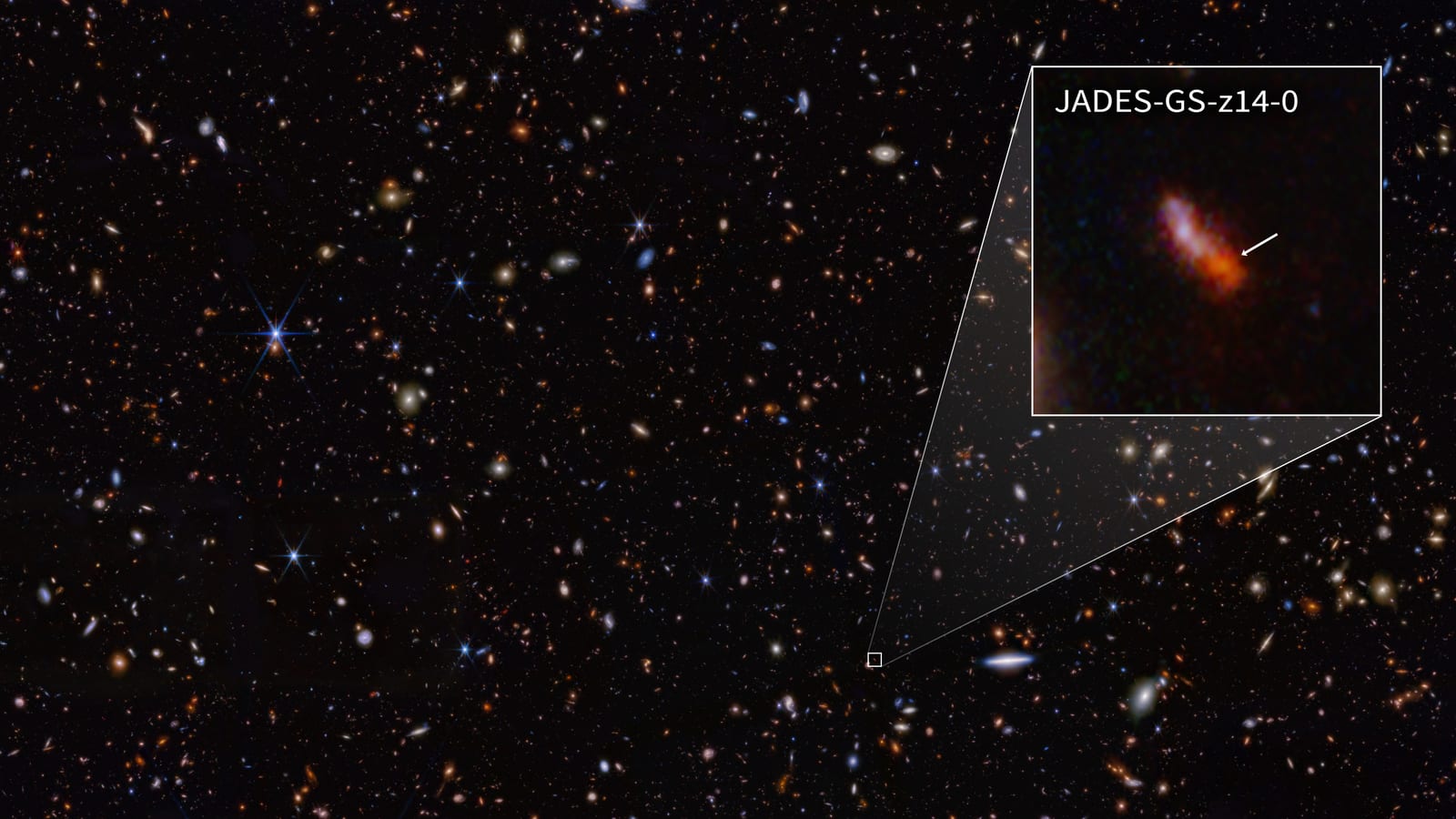
When astronomers using the James Webb Space Telescope (JWST) confirmed the redshift of a faint speck of light in the JADES survey field, they didn't just spot another distant galaxy. They identified the most distant galaxy yet seen - and one bright enough to challenge our models of how quickly the early universe assembled itself.
What happened
The galaxy, catalogued as JADES-GS-z14-0, sits at a redshift of z ≈ 14.3 - meaning the light we now see left it just 290 million years after the Big Bang. By the JADES team's measurements, it spans roughly 1,600 light-years across - surprisingly large for that epoch - and is far brighter in ultraviolet light than current models predict.
JWST's NIRSpec instrument was used in two observation campaigns (October 2023 and January 2024) to obtain a 28-hour spectrum, providing the spectroscopic confirmation needed to lock in the record-breaking distance.
What this breaks in the standard model
Standard cosmological models expect the very first galaxies to be small, dim, and chaotic - small clumps of mostly-hydrogen-and-helium stars still in the process of collapsing under gravity. A galaxy as bright and as large as JADES-GS-z14-0, this early in cosmic history, suggests one of three things:
- Early star formation was far more efficient than current models allow, churning massive stars into existence faster than expected.
- Compact structure formed earlier, with the first galaxies coalescing into recognizable shapes within just a few hundred million years of the Big Bang.
- Some of our timeline assumptions are off - possibly because dust or active black holes are subtly skewing brightness measurements at extreme distances.
Whichever is true, the JADES results - which now include thousands of candidate galaxies at redshifts above 8 - show the early universe was busier and more structured than the pre-Webb models projected.
Where the follow-up observations go from here
The team has additional time on Webb's Mid-Infrared Instrument (MIRI) to probe dust and older stellar populations within JADES-GS-z14-0, and the Atacama Large Millimeter Array (ALMA) will look for cold gas signatures in the radio. Several theory groups have already published papers proposing modifications to the standard model of early galaxy formation in light of these observations.
If you'd like to keep up with JWST's other early-universe finds - including the rest of the JADES survey - our astronomy section tracks the science as it lands.