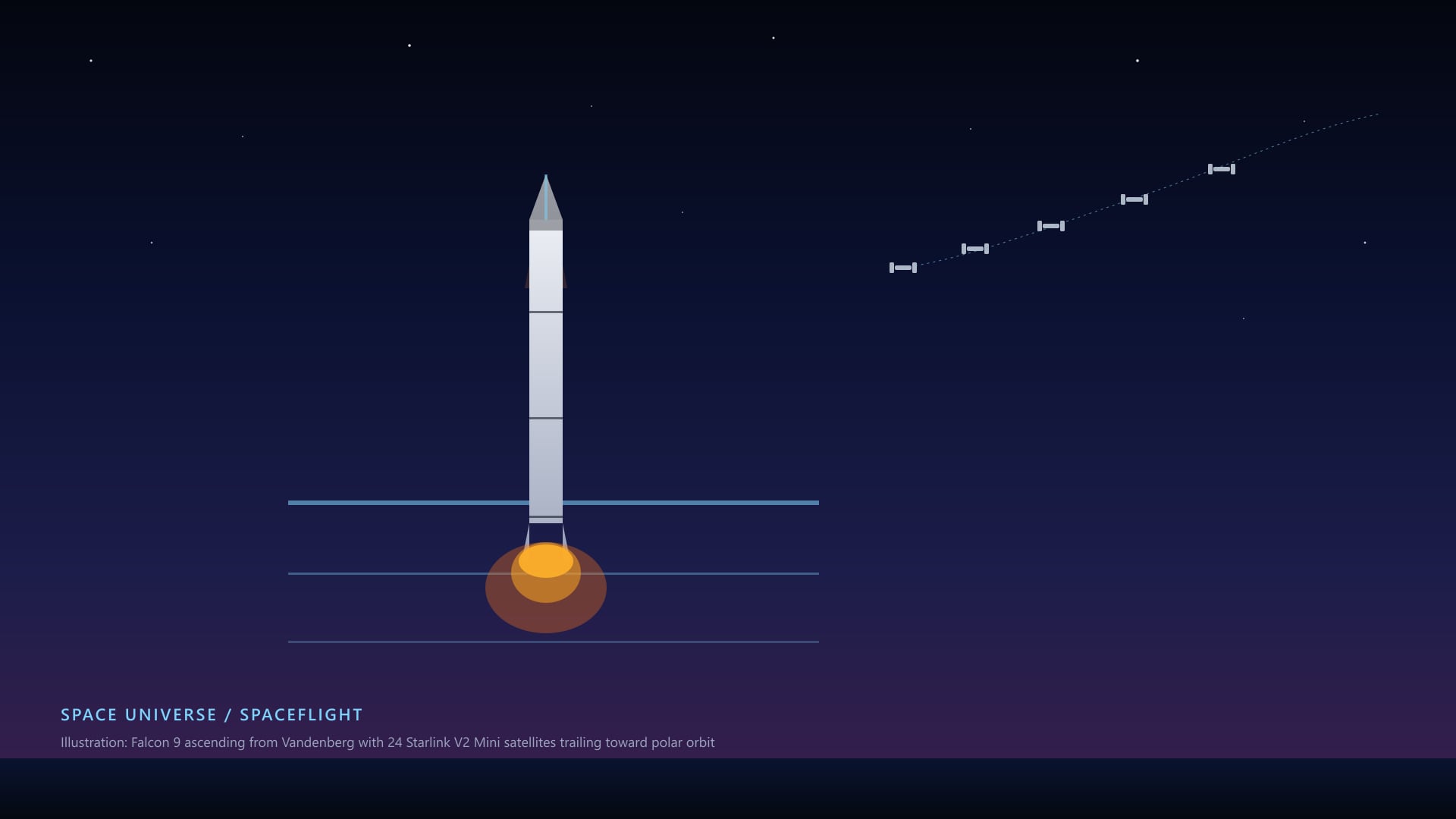
A Falcon 9 lifted 24 Starlink V2 Mini satellites off the West Coast in the early hours of April 30, 2026 (UTC), marking the second SpaceX flight in roughly half a day and pushing the year's Falcon 9 cadence past the 50-mission mark.
The mission - designated Starlink Group 17-36 - flew from Space Launch Complex 4 East (SLC-4E) at Vandenberg Space Force Base in California. Liftoff occurred during a four-hour window that opened at 02:00 UTC on April 30. About 8.5 minutes after launch, the first stage settled onto the autonomous droneship Of Course I Still Love You (OCISLY) in the Pacific. Roughly an hour after that, the second stage released all 24 satellites into a sun-synchronous orbit at 97.29° inclination.
For the constellation, this was a routine top-up flight. For the launch system itself, the booster's flight log is what stands out.
A 33rd flight for B1071, one of the fleet leaders
The booster on this mission was B1071, a Falcon 9 first stage that has been in service since early 2022 and is now one of the most-flown vehicles in SpaceX's reusable fleet. According to public booster databases tracked by the spaceflight community, this was its 33rd launch - and its turnaround from the previous flight (Starlink Group 17-31 on March 13, 2026) was about 47 days.
That puts B1071 in elite company. Only a handful of Falcon 9 boosters have ever crossed the 30-flight line, and each additional cycle pushes the data set on long-life reuse a little further. The fact that SpaceX is still flying high-cadence Starlink missions on these veterans, and recovering them on the same droneships, is part of why the company can sustain its pace without expanding the active fleet much beyond a dozen boosters at a time.
What's a "V2 Mini" satellite, and why does the orbit matter?
The 24 spacecraft on board are Starlink V2 Mini units - the workhorse design Starlink has been deploying since 2023 while the larger V2 satellites wait on Starship to enter service. V2 Minis are heavier and more capable than the original V1.5s; each one carries upgraded phased-array antennas, more bandwidth per beam, and Hall-effect thrusters that use argon for station-keeping.
Because they launched from Vandenberg into a near-polar, sun-synchronous orbit, this batch will fill in the Group 17 shell - the high-inclination part of the constellation that gives Starlink coverage at high latitudes. East Coast launches from Cape Canaveral typically populate lower-inclination shells (Groups 6 and 10) that prioritize the dense user base across the contiguous US, Europe, and Australia. The polar shell is what lets Starlink work in places like Alaska, northern Canada, Scandinavia, and on ships transiting the Northern Sea Route.
A back-to-back launch day
This Vandenberg flight came less than 13 hours after a different SpaceX launch on the East Coast: a Falcon Heavy lifting Viasat's ViaSat-3 F3 satellite from Kennedy Space Center's LC-39A on April 29. That mission ended an 18-month hiatus for Falcon Heavy and was originally scheduled for April 27 before weather pushed it back twice.
Two launches from two different coasts inside a single calendar day is no longer unusual for SpaceX, but it is still a useful proof point of the operational tempo the company has built up. Each launch site has its own dedicated team, droneship, recovery aircraft, and pad turnaround crew; what makes the back-to-back possible is that none of them have to wait on a centralized resource to flow between coasts.
The numbers, in context
A few data points from this launch worth pinning down:
- Mission designation: Starlink Group 17-36 (Group 17 = polar shell)
- Vehicle: Falcon 9 Block 5
- Launch site: SLC-4E, Vandenberg SFB, California
- Liftoff window: 02:00–06:00 UTC, April 30, 2026
- Payload: 24 Starlink V2 Mini satellites
- Target orbit: Sun-synchronous, ~258 × 271 km, 97.29° inclination
- Booster: B1071, 33rd flight, 47-day turnaround
- Landing: Droneship Of Course I Still Love You, Pacific Ocean
- Falcon 9 missions in 2026 so far: 51
It is the kind of flight that, five years ago, would have been the year's headline. In 2026 it is the second-newest Falcon 9 mission on the manifest by the time you finish reading this.
What's next from Vandenberg - and from the rest of the fleet
The Vandenberg pad has been turning around quickly. Recent operations show a roughly 3-day gap between the previous SLC-4E launch and this one, which is fast even by SpaceX standards. Expect the next West Coast launch - most likely another Group 17 Starlink batch - within a similar window, weather and droneship turnaround permitting.
On the East Coast, the next Starlink mission is currently expected on May 1, 2026 from Cape Canaveral, which would chain three Falcon launches in three days. SpaceX's published manifest is the best place to confirm - the live cadence shifts often as weather, range conflicts, and droneship readiness slide individual flights by a day or two.
Why this matters for the broader Starlink picture
Each new batch of V2 Minis does three things:
- Replaces aging spacecraft that are being deorbited at end-of-life (Starlink runs an active fleet of roughly 7,000+ active satellites and continuously retires older ones).
- Densifies the constellation in priority shells, which lifts capacity per cell and lets Starlink push higher data rates and lower latency to existing users without adding new ground stations.
- Expands geographic coverage, especially in the polar regions that Group 17 serves - useful for maritime, aviation, and government customers who need links above 60° latitude.
The constellation is now mature enough that a single 24-satellite launch barely moves the global capacity needle. It does, however, shore up specific shells, and Group 17's high latitudes are exactly where the constellation is hardest to grow without dedicated polar-orbit launches like this one.
For everything from constellation-status math to upcoming launches and reusable-booster milestones, follow the spaceflight beat - that's where every Falcon, Starship, and Starlink update lives on this site.